

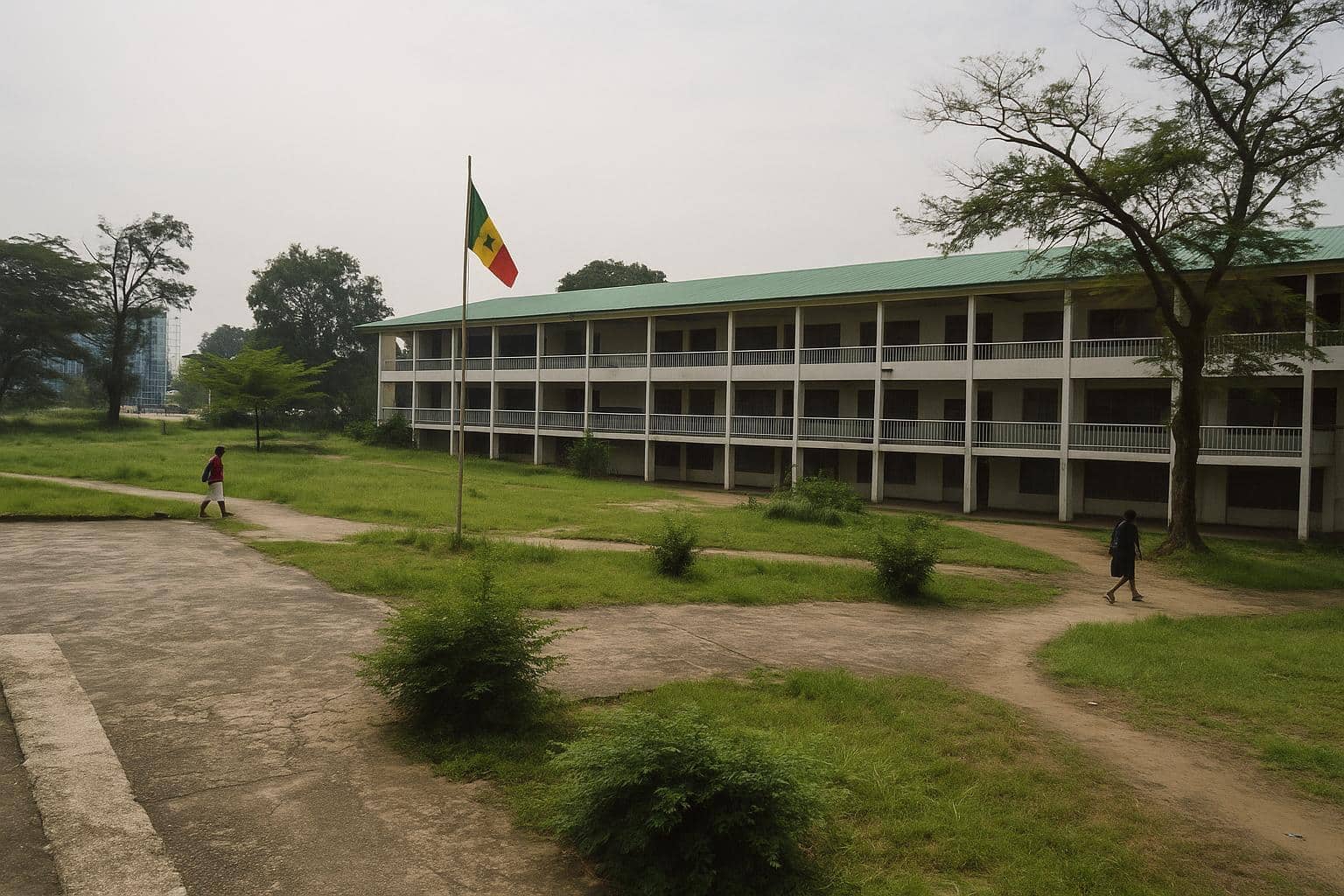
Salary Arrears Stir Academic Standstill
In the shimmering midday heat of Brazzaville, the lecture theatres of Marien-Ngouabi University—normally abuzz with more than 45 000 students—echo only the hum of ceiling fans left idling. The National Union of Higher-Education Lecturers confirmed that its members initiated a work stoppage in mid-November to press for payment of at least five months of overdue salaries (Union communiqué, 18 Nov.). Entering a third consecutive week on 1 December, the strike has crystallised a debate on how best to cushion the public university system against cyclical budget pressures.
Officials at the Ministry of Public Service recognise the arrears and attribute payment delays to a tight cash-flow calendar linked to the gradual recovery of petroleum receipts following the 2020 global downturn (Ministry brief, 25 Nov.). While no official figure has been released, a senior treasury source, speaking off the record, placed the wage backlog for higher-education personnel at “under XAF 6 billion, or roughly two months of the annual payroll”, a level he described as “manageable provided disbursement sequencing is agreed”. The explanation has not entirely placated lecturers who argue that regular remuneration is essential for research productivity and the university’s regional reputation.
Executive Engages in Structured Dialogue
Mindful of the stakes, the government has multiplied consultation channels rather than imposing emergency decrees. Prime Minister Anatole Collinet Makosso tasked Higher Education Minister Delphine Edith Emmanuel Adouki with leading a joint task force bringing together the ministries of finance, public service and oil, as well as representatives of the university’s governing board. According to the minister, the body met twice during the last week of November and is preparing “a timetable for progressive clearance of arrears alongside a mechanism that forestalls future accumulations” (press point, 30 Nov.).
Insiders to the talks indicate that solutions under review range from a three-tranche settlement of wage arrears to the earmarking of a portion of forthcoming oil-sector windfalls for a stabilisation fund dedicated to higher education. Several union delegates characterised the atmosphere as “frank but constructive”, noting that the executive has refrained from any ultimatum and is instead requesting a phased resumption of classes in tandem with first payments.
Student Body Voices Anxiety and Resilience
For the student community, the stoppage has been both disruptive and revealing. Grace Nkodia, a third-year physics major, said she worries about “slipping behind continental peers in laboratory skills”, yet adds that she understands professors’ frustrations. First-year law student Exode Mabiala, by contrast, fears a protracted freeze could imperil scholarship renewals calibrated to academic calendars. Still, informal study groups have sprung up across campus lawns, while the administration has kept libraries and digital learning hubs open in coordination with the Ministry of Youth and Civic Education.
Student Union president Arsène Loubaki confirmed that his organisation has urged the parties to sign a memorandum of understanding swiftly, stressing that “every week lost translates into costly extensions of the academic year and, ultimately, into higher expenses for families already grappling with inflation”. He nevertheless welcomed the government’s readiness to involve student observers in the task-force’s next round, arguing that inclusive governance strengthens institutional trust.
Sustainable Funding at the Heart of Reform
Beyond the immediate pay issue, economists see the dispute as emblematic of a broader quest to recalibrate public-sector wages to commodity-linked revenue cycles. The Congolese Observatory of Public Finance notes that between 2014 and 2020 oil prices fell by over 50 %, narrowing fiscal buffers that had previously underwitten education spending (Observatory report, July 2021). While prices have partially rebounded, budget controllers emphasise the prudence of establishing ring-fenced accounts for priority sectors to mitigate future volatility.
Parliament is poised to examine a draft Higher-Education Financing Bill early next year that would introduce multi-annual appropriations, improve payroll digitalisation and encourage public-private research partnerships, thus diversifying revenue streams. Analysts believe adoption of such structural measures could render salary arrears an exception rather than a recurrent headline.
For the moment, attention remains fixed on the negotiating table. Should the promised first tranche materialise within days, unions have signalled a willingness to return to classrooms, thereby safeguarding semester examinations scheduled for late January. In the words of a veteran sociology professor: “Our vocation is to teach; the strike is not an end in itself. If dialogue produces a credible roadmap, chalk will once again meet blackboard, and students will regain the rhythm they deserve.”