

Strategic partnership nurtures rural entrepreneurship
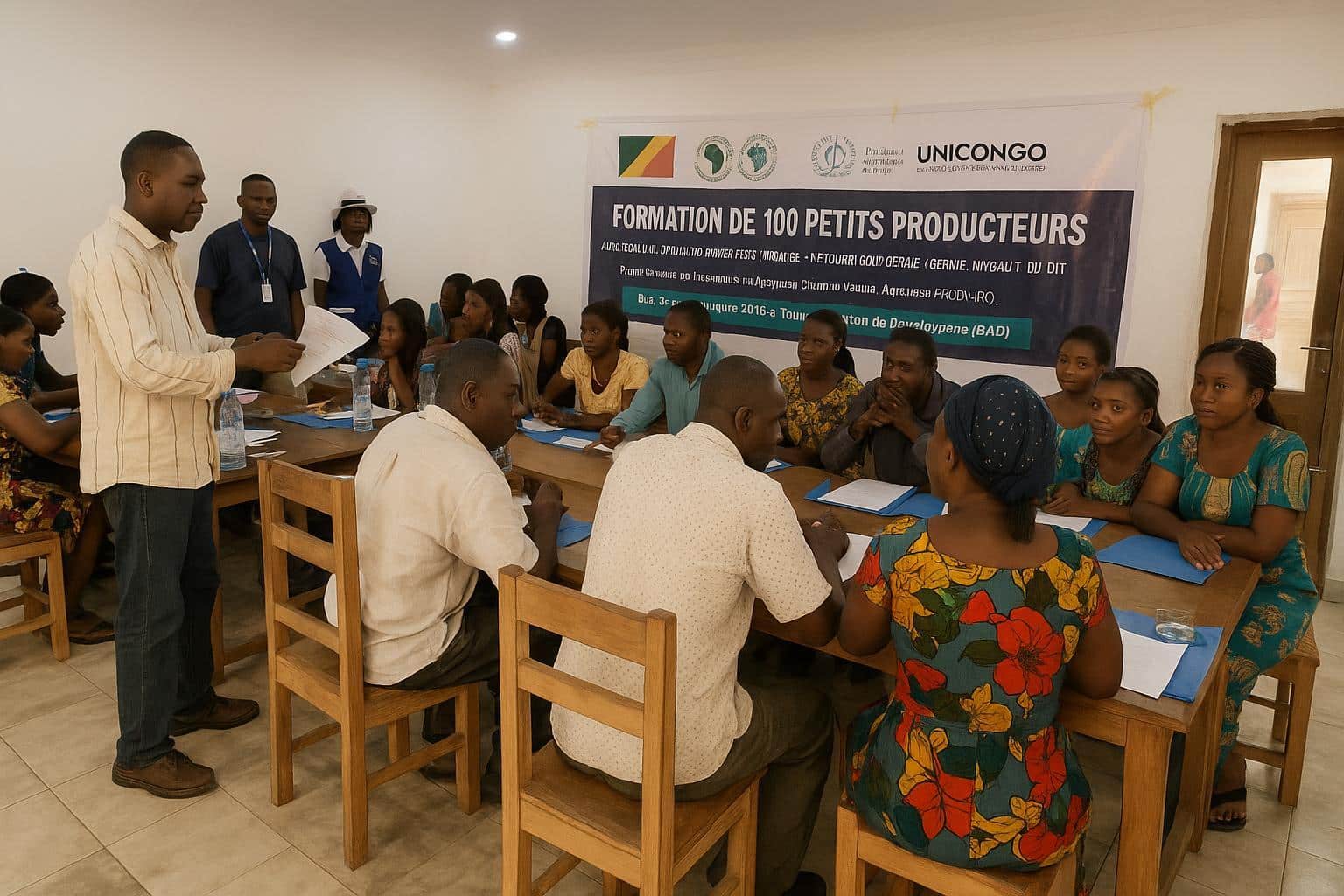
On the red lateritic roads that wind through Mindouli, the International Labour Organization, commonly still referred to by its French acronym BIT, has joined forces with the Integrated Agricultural Value Chain Development Project, Prodivac, to deliver an unprecedented capacity-building session for one hundred small-scale producers drawn from Kinkanda, Kingoyi and Mindouli. Financed by the African Development Bank, the programme ran from 27 November to 13 December and was carefully structured in cohorts of twenty, ensuring the intimate pedagogical environment that adult learning theories recommend. Twenty business counsellors, themselves previously certified in level I of the BIT approach, acted as facilitators, turning the town’s modest training centre into a laboratory for rural entrepreneurship.
Inside the GERME methodology
The course, entitled “Gérez mieux votre entreprise” – widely known under the English acronym GERME for “Get Ahead, Manage Better” – moves far beyond bookkeeping tutorials. Its conceptual spine interlaces procurement planning, stock management, market positioning, cost estimation, group governance and elementary human-resource administration. Each concept is immediately tested through role play and peer-to-peer feedback, an approach that, according to the counsellors, accelerates retention and encourages collective problem-solving. By the close of the first module, participants were already sketching rudimentary cash-flow statements and mapping seasonal demand curves for cassava, maize or cattle. “Our ambition is to make the language of business as familiar as the language of the fields,” observed lead trainer Andely Beeve Baptiste-Junior, his remark greeted by discreet but determined nods from the packed classroom.
Voices from the training hall
The power of the curriculum surfaced most strikingly when the discussion shifted to the delicate interface between enterprise and extended family, a question that often defines the fate of African start-ups. Albert Ngoma, a fifty-seven-year-old cattle breeder, and Raymonde Bassilaho, a fifty-one-year-old crop farmer, seized the floor to explain how the module had helped them quantify informal support as well as informal pressure. “Success requires risk-taking, strategic vision and teamwork,” they agreed, noting that family bonds, while invaluable, must be channelled through transparent norms if a venture is to grow sustainably. Their plea was unambiguous: extend the training to every farmer in the Pool and, in due course, to the rest of the Republic of the Congo so that the new culture of enterprise becomes collective capital rather than an isolated privilege.
Towards decent jobs for Pool youth
Beyond individual skill acquisition, the initiative pursues a broader public-interest objective: the creation of more numerous and more decent jobs in agriculture, particularly for young people who too often view the sector as a fallback option. Prodivac’s national ILO coordinator, Gloria Ondako Oket, used the programme’s second day to remind participants that knowledge is an asset only when consistently updated and shared. Her exhortation was met with renewed concentration, suggesting that the seeds of a self-sustaining learning community have already been sown. If the follow-up mentoring promised by the counsellors materialises, Mindouli could well become a demonstrator town where value chains and human capital evolve in tandem, reinforcing not only household incomes but also the region’s food security and social cohesion.