

A Deliberate First Step Toward Global Water Diplomacy
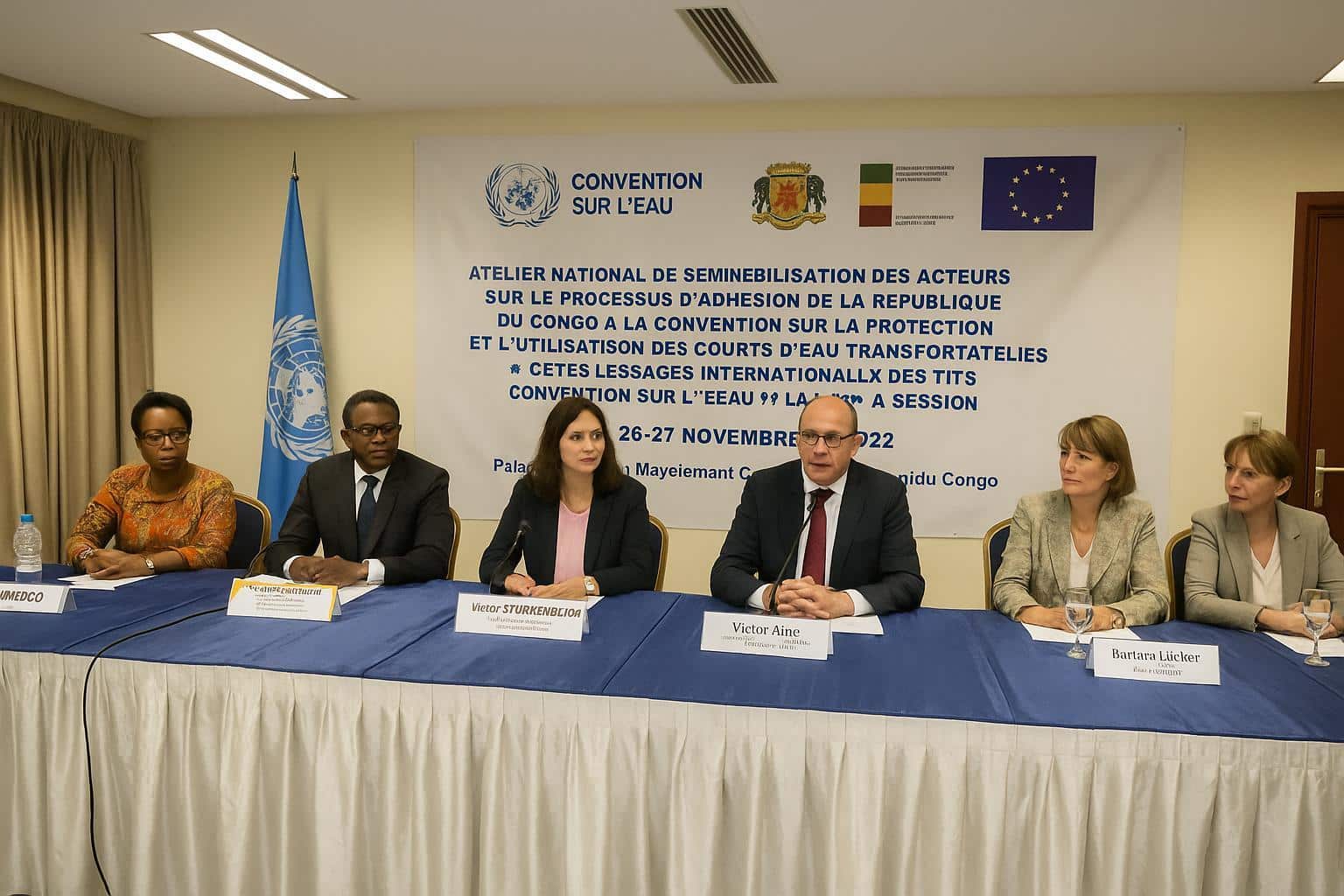
In a hall overlooking the banks of the Congo River, senior civil servants, diplomats and technical experts gathered on 26 November for an unprecedented policy conversation: preparing the Republic of Congo’s accession to the 1992 Convention on the Protection and Use of Transboundary Watercourses and International Lakes. The workshop, opened by Frédéric Manienze, chief of staff to the Minister of Energy and Hydraulics, signals Brazzaville’s determination to embed water governance within an international legal framework while climate pressures intensify across Central Africa.
Why the 1992 Convention Matters for Congo
Adopted under the auspices of the United Nations Economic Commission for Europe and since globalised, the treaty commits its Parties to prevent, control and reduce transboundary water pollution, to promote equitable utilisation of shared resources and to establish joint monitoring mechanisms. For Congo, whose vast hydrological network is interlaced with the Democratic Republic of Congo, Cameroon, the Central African Republic and Gabon, such principles resonate strongly. According to Sonja Koeppel, secretary of the Convention, ratification would not only strengthen domestic water management but “raise the country’s profile internationally and facilitate access to national and international financing.” Her assessment echoes internal government analyses that identify water diplomacy as a lever for climate adaptation finance and technology transfer.
A Response to Persistent Access Gaps
The urgency is underscored by sobering data. UNICEF estimates that approximately forty-four percent of Congolese people do not have reliable access to improved drinking-water sources. In peri-urban settlements around Brazzaville and Pointe-Noire, women still spend hours queuing at standpipes during the dry season, while rural schools operate without functional boreholes. Abdourahamane Diallo, United Nations Resident Coordinator in Congo, reminded participants that joining the treaty could “protect and ensure the sustainable use of transboundary groundwater”—a resource that remains under-mapped yet increasingly vital as surface water regimes fluctuate.
Diplomatic and Financial Incentives Align
European Union support, voiced by Ambassador Anne Marchal, adds a geopolitical dimension to the process. The EU champions the Convention as a universal norm and finances capacity-building in several African basin organisations. For Congo, alignment with Brussels and other donors may widen the pipeline of grants dedicated to water, sanitation and climate resilience. Moreover, the treaty’s reporting obligations oblige Parties to adopt transparent data protocols, a requirement that dovetails with the government’s broader modernisation agenda embedded in the National Development Plan 2022-2026.
Building National Consensus Through the New Advisory Council
Beyond international symbolism, the workshop created the country’s first ad hoc National Consultative Council on Water. Manienze defined its mandate as threefold: disseminating the Convention’s principles, harmonising stakeholder positions and drafting a public roadmap toward accession. Representatives from riverine communities, hydropower operators, municipal utilities and civil society were invited to voice recommendations on shared monitoring stations, pollution contingency planning and groundwater mapping. Such inclusive deliberation, rarely attempted in the water sector, may help pre-empt local disputes and foster ownership of future obligations.
Next Milestones on the Accession Timeline
Participants agreed to compile workshop conclusions into a formal Cabinet memorandum by early 2024, paving the way for presidential submission of the treaty to Parliament. Once ratified, Congo would deposit its instrument of accession with the United Nations Secretary-General and join a community of forty-seven Parties spanning Europe, Africa, Latin America and Australasia. Technical cooperation could then accelerate on the Oubangui-Chari hydrological corridor, where sedimentation, artisanal mining and navigation intersect with fragile floodplains.
Balancing Ambition With Implementation Capacity
Observers caution that membership alone will not close the country’s water gap. The Convention demands regular joint assessments, early-warning systems and rehabilitated infrastructure—tasks that require sustained budget allocations and skilled personnel. Yet the government’s choice to embrace a legally binding instrument attests to a maturing institutional culture of accountability. “Our objective is to transform water from a potential source of friction into a driver of cooperation,” Manienze summarised, reflecting a forward-looking posture consistent with President Denis Sassou Nguesso’s emphasis on regional stability.
A Strategic Pivot in the Climate Era
As Central Africa confronts erratic rainfall, rising urban demand and the spectre of cross-border disputes, Congo’s overture to the 1992 Water Convention constitutes a strategic pivot. By articulating a timetable for accession, establishing an inclusive advisory body and courting external partners, Brazzaville positions itself as a responsible custodian of one of the planet’s most extensive river systems. The coming months will test the country’s capacity to translate diplomatic resolve into concrete reforms; success could set a benchmark for equitable and sustainable water management across the sub-region.