

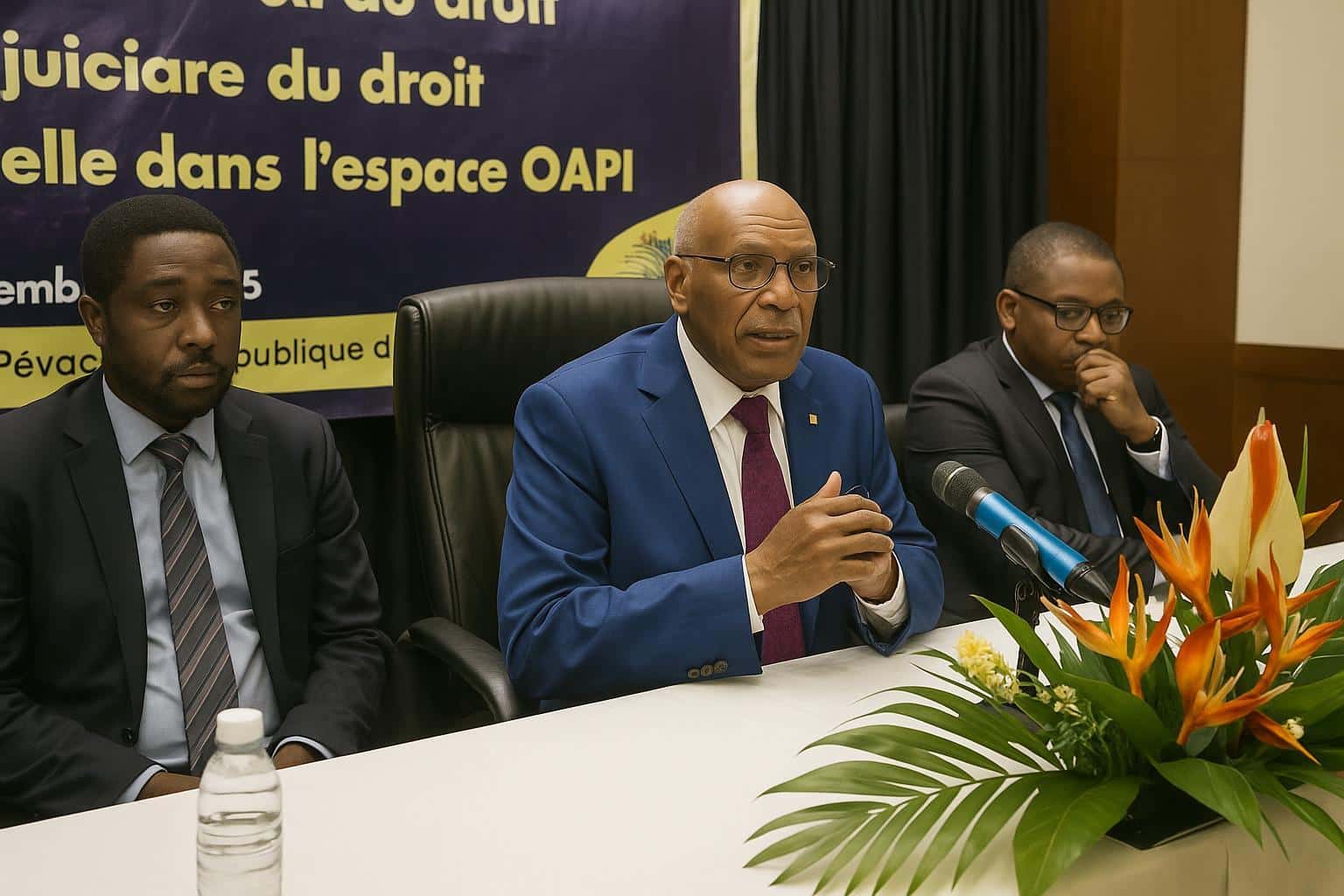
Strategic Capacity Building for the Judiciary
From 4 to 11 November, the commercial heart of Brazzaville hosted an intensive seminar that placed intellectual property (IP) at the core of judicial practice. Jointly convened by the Ministry of Industrial Development and Private-Sector Promotion and the Ministry of Justice, Human Rights and Promotion of Indigenous Peoples, with technical support from the African Intellectual Property Organisation (OAPI), the initiative aimed to accelerate the Republic of Congo’s alignment with continental IP standards. Fifty-five magistrates, drawn from courts of first instance and courts of appeal across the country, accepted the challenge.
“A sound culture of intellectual property is indispensable to economic diversification,” observed one facilitator, noting that the copyright, trademark and patent disputes now emerging in Congo-Brazzaville mirror the country’s growing creative and industrial sectors.
Nine Modules Bridging Theory and Practice
Delivered by eminent jurists familiar with OAPI jurisprudence, the curriculum unfolded around nine carefully sequenced themes. The opening sessions mapped the conceptual terrain of intellectual property, distinguishing industrial property – patents, trademarks and designs – from literary and artistic rights. Subsequent lectures dissected Congo’s judicial architecture, before plunging into the procedural subtleties of infringement litigation, seizure-counterfeit measures and evidentiary standards.
A particularly lively debate revolved around artificial intelligence and copyright protection, a frontier topic that challenged participants to reconcile traditional authorship doctrines with generative technologies increasingly present in local audio-visual production. Throughout, facilitators alternated expository talks with moot-court simulations, ensuring that doctrine translated into reflexes applicable in real dockets.
Clarifying Jurisdictional Boundaries
One recurring concern among magistrates was the precise distribution of competence between commercial courts and courts of general jurisdiction. Trainers responded with comparative insights from Cameroon, Côte d’Ivoire and Senegal, states whose jurisprudence under the OAPI banner has already refined such demarcations. By week’s end, participants reached a consensual position: while commercial courts retain primary authority over disputes anchored in market transactions, high courts remain competent when the claim implicates public-order considerations or criminal counterfeiting.
This consensus paves the way for a draft law on jurisdictional allocation, a recommendation formally transmitted to the government at the closing ceremony.
Recommendations Anchored in Harmonisation
Beyond statutory reform, participants urged the two organising ministries to institutionalise periodic IP training and to weave dedicated modules into the National School of Administration and Magistracy. They also called on the Higher Council of the Judiciary to disseminate landmark IP rulings in a dedicated law report, facilitating citation and fostering predictability for investors.
Magistrates further advocated systematic consultation of decisions issued by other OAPI member states so as to accelerate jurisprudential harmonisation – a cornerstone of the organisation’s mission since its 1977 Bangui Agreement.
A Continental Network Beckons
Closing the proceedings, Antoine Thomas Nicéphore Fylla Saint Eudes, Chair of OAPI’s Board of Directors, congratulated the cohort on its “disciplined commitment to a domain that will increasingly shape Africa’s knowledge economies.” He invited all graduates to enrol in the African Network of IP-Specialised Judges, an emerging forum for peer exchange that promises to consolidate Congo’s voice in regional standard-setting.
With this newly forged expertise, Congo-Brazzaville positions its judiciary to adjudicate creative and industrial disputes with celerity and confidence, reinforcing investor trust while safeguarding national ingenuity. The ultimate beneficiaries are Congolese innovators whose patents, brands and artistic works require vigilant, informed protection in an interconnected marketplace.